Why Their Political Beliefs Don't Matter: Hurston & Hughes

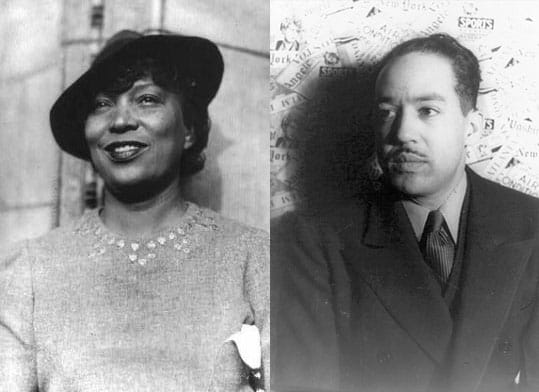
Did I catch your eye with that title? I must admit, it is a bit of clickbait. The political beliefs and affiliations of anyone or anything always matters, to a degree. However, the impact those people have on society can extend beyond their beliefs, and also contrast them. Zora Neale Hurston and Langston Hughes are two prolific African-American writers from the period known as the Harlem Renaissance who both had strong and vocal political beliefs during their most active years. Both wrote pieces surrounding the topics of African-American life in the United States during the early 20th century, and both were present in the same social circles. Their politics differed heavily, often being polar opposites.
Growing up in Florida, Hurston was a conservative who supported and believed in conservative causes and movements. She supported segregation in schools, and argued against the causes of communism. It is important to understand her arguments, and where they came from, even though we disagree. Her arguments about school segregation were that an African-American has the motivation and desire to educate his or her fellow African-Americans to the same degree that Whites are educated. However, combining the two into a school primarily run by Whites will lead to African-American students being undervalued and poorly supported in education. She saw the racism around her, and noticed that Whites at the time were not interested in being equals, and should they be forced to, systemic racism would move 'underground' as it were. She, unfortunately, was not incorrect about that last point. Desegregation has brought significant progress to African-Americans in the US, and has opened up innumerable opportunities that were never afforded prior to the Civil Rights Movement 30 years after Hurston's main political advocacy. Yet, it has indeed allowed and safeguarded systemic racism in ways that are incredibly difficult to combat by design. African-American students are more likely to be punished, and punished harsher, than their White classmates. Systemic racism in other areas often means most African-American students attend schools that are underfunded and provide subpar education, hurting their long term success. It is clear that while Hurston was incorrect about the supposed evils of desegregation, she was indeed correct in her assessment of the systemic racial movements as a result of it.
Her writings included many allusions to personal experience of an African-American, as opposed to systemic racism felt by them at large. In Their Eyes Were Watching God, Hurston used the book to tell the story of an African-American woman in Florida, touching on topics of slavery, sexual assault, unequal applications of justice, and more. It has been criticized by some for not discussing the broader reason for such treatments within the story, instead focusing only on the plight of the main character Janie. These criticisms miss the fact that it does focus on a personal story, a story that many back then, and still many today, can relate to thanks to the racism in the United States. Focusing on a personal story, and the individual impacts of systemic racism on an African-American woman in the South does not by itself ignore but rather supports the larger narrative about African-American liberation. Understanding the impacts of systemic racism through the fictional account of a woman is a powerful tool to convey their emotional impact and detriment to quality of life for millions of Americans today.
Hurston's politics, therefore, influenced her work on Their Eyes Were Watching God. She wrote a novel based on her beliefs that a person in the face of such systemic racism must have an individual response to it. A denial of systemic issues, and an issue of personal resilience and defending one's rights individually. We see a novel that embodies those points, but, it hides many more. It hides systemic racism in every page, as if it were sunlight shining through fog. It highlights issues faced by women and by African-Americans across the US during the era the story is set, and also during the era Hurston penned it. It is used across the US in African-American History classes and scholars to analyze the era with which it was written and the impacts on the characters. It is read by those across the political spectrum, and predominantly is a vessel to support and encourage African-American liberation in the face of inequalities perpetrated by the American ruling classes. It has transcended her political views, and it has been an appropriate and powerful driving force towards understanding and improving revolutionary movements. Hurston's political beliefs were flawed, quite so, and at the time she was used widely by the White conservatives to justify their beliefs and actions. She wrote stories that grew from her political beliefs, as every writer does. You can search her work, and see her politics. But you can also read further and find strong, pro-liberation, pro-revolutionary arguments abound in them.
Langston Hughes, by contrast, was a supporter of communism during his active years. He wrote many poems, such as Scottsboro Limited, that advocated for worker empowerment and ownership. He advocated for desegregation, and advocated for equality between African-Americans and Whites. He spoke fondly of the USSR, and even went as far as excusing the infamous Purges by Stalin by being a signatory on the article titled Letter to American Progressives. He was brought to the USSR in order to assist in directing a film that depicted the living conditions of African-Americans in the US, however this film was never made. In his works, we see obvious calls to organize, calls for justice, revolutionary ideals, and more. His communist leanings are evident in his work. They present themselves obviously and based on the environment they were written within. African-Americans were a second class to Whites in every sense. The fight for justice and equitable treatment was one that was not yet mainstream, and wouldn't be for many decades. Hughes' political beliefs were incorrect at times, such as defending Stalin's Purges which we know now to have been a detriment to the quality of life of those in the USSR. In his later years, during the times of McCarthyism, he was brought to speak to his beliefs which he disavowed, stating that he was not a communist party member. Many see these things and discount Hughes' involvement in American Communism in the first half of the 20th century. Yet, his words remain true and remain powerful. His political missteps did not expunge the truth of his works. His specific communist ideology did not suddenly mean the poems rang hollow for those of other ideologies.
Both Hughes and Hurston wrote now acclaimed works. They both focused on African-American living conditions, created the characters that interact with it, explored their political beliefs through these characters. Yet, despite their opposing political beliefs, and despite their opinions and understandings of systemic issues facing African-Americans, we see today that their work has taken a life of its own, through analysis by readers and through a deeper understanding of their lives as they wrote. The Harlem Renaissance gave us a window not seen prior into the lives of the African-American people in the US through novels, poems, and folklore depictions. The political beliefs of these many authors has since been forgotten by many. Their works, a product of their beliefs, have moved onto a life and voice of their own. A communist can read Their Eyes Were Watching God and come to the conclusion that systemic issues that caused Janie's suffering need to be challenged and abolished despite its original political origin. An anti-USSR socialist can read Scottsboro Limited and agree with the poems message, despite it's Soviet messages.
We hear often "separate the art from the artist," often in defense of still-living bigots like JK Rowling. It is important to always understand the political origins of any work. One can appreciate HP Lovecraft, but also recognize his racism and see it presented in his works. One can read Hurston's novels, and pull a communist message from them despite their original conservative starting point. Their politics matters as a point of understanding. A lens to see their work and interact with it in a true and meaningful way. But, to circle back to the clickbait title of this article, their political beliefs do not change the fact that their works highlight and express plights that were and continue to be faced by millions of African-Americans across the US. It does not change that their messages lend themselves directly to liberation of African-Americans, despite differing paths to do so. Their politics created their words, but their words speak for themselves. Reading a book, and treating it with the respect it deserves, often leads to messages authors never intended, and leads to new discoveries and messages that were hidden from even the author themself.
In Solidarity,
FurInform
Sources:
Their Eyes Were Watching God - Zora Neale Hurston
Scottsboro Limited - Langston Hughes
Letter to American Progressives - 1938, Multiple Authors
Transcripts from the US Senate during hearings regarding Langston Hughes - 1953
Why the Negro won't Buy Communism - Zora Neale Hurston
Public quotes by Zora Neale Hurston - 1938-1951