Thanksgiving History
In a past article from last fall, we touched on the holidays of Dia De Los Muertos and American Thanksgiving. Two holidays at the center of a debate surrounding settler colonialism and genocide. We addressed how these holidays should be used as a vessel to improve social cohesion and community, and should be a point of education for the masses instead of a beacon for ethnocentrism and fallacy by the right. We discussed how one should not outright rebuke these holidays, but instead expand their understanding of them and use it as a way to gently correct and take back the narrative to a revolutionary one. Attacking a holiday can cause disillusionment for those who aren't already on your side, and cultural holidays serve a social purpose that is subconsciously appreciated by many. Yet, despite this point which we still agree with, it is also important to understand the history behind holidays, and to combat them and change them for the better. We can still make sugar skulls and have ofrendas, but also acknowledge and venerate the precolonial Meso-American people. We can still get together and have turkey in November, while also not using the holiday to hide a genocide of an entire continent of people. We can preserve and maintain their cultural or social purpose, and combat directly and wholly their history.
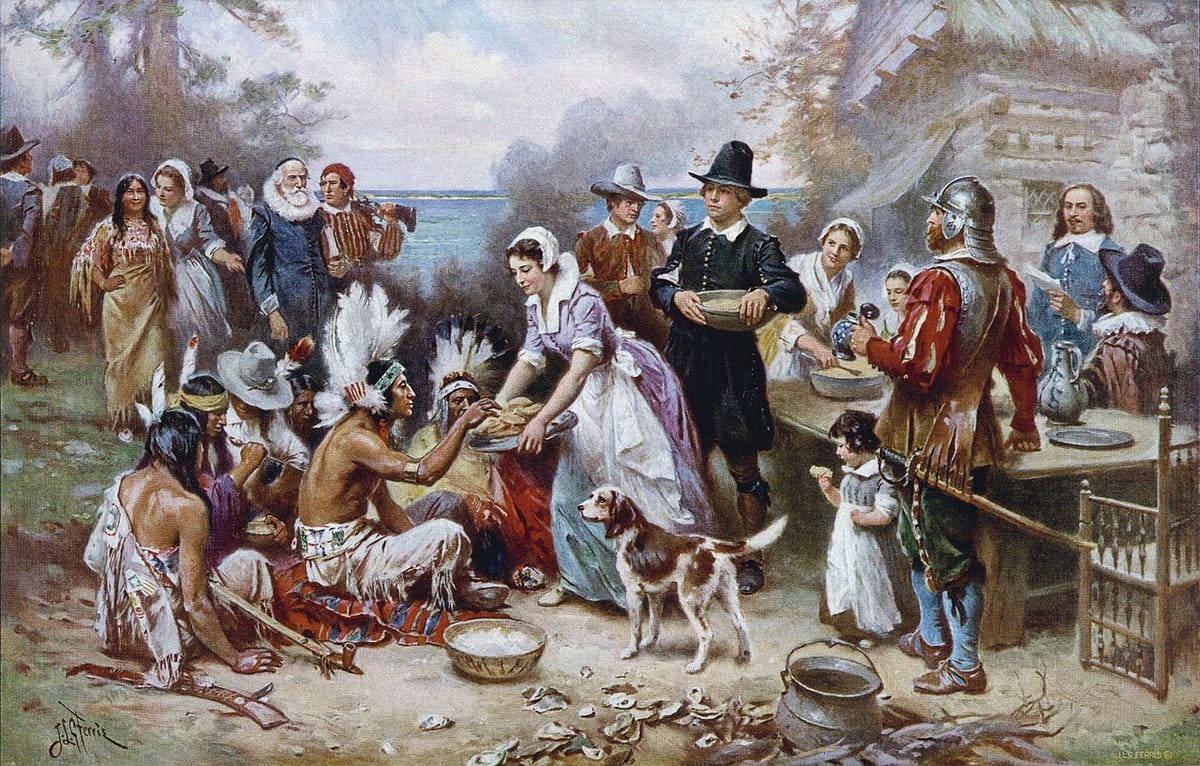
While we'd love to delve into both holidays in this article, it behooves us to focus on one to give it the weight it deserves. For this reason, in this article we will focus solely on American Thanksgiving. The holiday originates in New England, a name given to a region of the United States by settlers usurping the many names for the region created by its people, many of which are unfortunately lost to time. The "First Thanksgiving" that many are taught about in school took place in what is nowadays called Plymouth in the state of Massachusetts, originally called Patuxet by the indigenous Wampanoag People, in 1621. When the English settlers had landed in Patuxet, they had struggled to find a reliable source of food and had suffered a brutal winter. Applying their European sense of territory, they claimed land that was shared by the Wampanoag, who largely did not antagonize the strange people from the sea. After barely surviving the winter in 1620, the Wampanoag had taught the Englishmen cultivation skills for native crops such as corn which had allowed the settlers to have a bountiful harvest in 1621, and they held a feast to celebrate. Various sources conflict about the Wampanoag's inclusion to the celebration, or the actual happening of the event itself. Some sources claim that it was a harmonious celebration between both groups, while others state that the Wampanoag received no invitation but when they arrived to the English village, they were begrudgingly included in the feast which had already mostly been eaten. However, it was not to celebrate a massacre against the Wampanoag, or victory in a conflict between the English and Indigenous, and both sources confirm this.
As the years progressed, the holiday became an annual celebration in the English Massachusetts Colony, and surrounding New England Colonies. Despite this, and its origin, it took place alongside some horrible tragedies caused by the English in their territorial expansion and genocidal beliefs about eradicating Indigenous People in their newly claimed locale. Examples such as the Mystic Massacre and the Great Swamp Massacre. The Mystic Massacre took place in 1637, only a few years after the First Thanksgiving. English settlers in the Connecticut Colony with allied Indigenous tribes were in a supposed (though primarily) one sided war with the Pequot Tribe of Southeastern New England. The Pequot Peoples had constructed a wooden fort near modern day Stonington and Groton, Connecticut, and the Englishmen and their allies set fire to it and massacred its inhabitants as they attempted to escape. The Great Swamp Massacre is a similar story. In 1675, after decades of genocidal war against the Indigenous Peoples of New England, another massacre took place in an area in modern day South Kingstown, Rhode Island. This time, the attack was targeting the Narragansett People. The fort built within the Great Swamp was attacked by the English forces who led a massacre against all its inhabitants, including women and children, leading to massive casualties on the side of the Narragansett People.
The number of massacres that happened prior to the American Revolution is far more than we've discussed so far, and exceeded the bounds of the New England Colonies. Massacres and battles against Indigenous Peoples by English settlers took place across the entire eastern seaboard of the modern US and Atlantic Canada, and the Spanish committed similar acts in their Floridian Colony before it became a part of the US. Battles started as early as the Roanoke Colony which took place in the 1500's. The English, having already colonized the territory of Ireland in the century leading up to the American Colonization Project, they applied many of the same tactics to their conquest. Replacement policies, genocidal battles, egregious overreactions to reciprocal actions caused by the English, and so on. The things we see in other settler projects were present in the American and Canadian Colonies.
The attrocities did not cease, unfortunately, with the independence of the United States from Great Britain. Westward expansion, enabled by the sale of the French Settler Colonies in the US by means of the Louisiana Purchase allowed for the genocide and displacement of Indigenous People via so called Manifest Destiny. Massive movements of settlers into previously Indigenous communities where settlers were encouraged, often through direct fiscal rewards, to massacre and maim Indigenous Peoples. Tactics were brought from the prior English Colonies, those being divide and conquer. Convince Indigenous Tribes to fight one another, in order to reduce their numbers and then turn on your now more precarious allies to take their territories as well. Sign binding Treaties that are often written under conniving circumstances that overwhelmingly support the Americans more than the Indigenous, and then proceed to ignore said Treaty altogether. Assimilate Indigenous Peoples, and then still commit a genocide against them, as seen in the Cherokee Tribe's Trail of Tears, and in the Creek People being forced out of their homeland in the Deep South until they reached the Everglades in Florida.
It goes without saying, the list of atrocities committed by the English and the subsequent Americans against Indigenous Peoples is one that is lengthy, and likely woefully incomplete thanks to historical revisionism by Americans and English. Tribes were wiped out, languages were made extinct, children were kidnapped from parents, Indigenous Peoples were disproportionately the victims of sexual violence. A continent of people far more diverse than Europe were virtually erased from the contemporary record by a select few European states. Waves of violence, waves of atrocities, waves of treaty violations. These things unfortunately continue today. Both from systemic racism by Americans at large, as well as via direct government treatment. We saw the federal government shoot water cannons at protestors on Tribal Land they rightfully had sovereign right over that the US government was actively violating during the Standing Rock Protests. We see the murder rate for Indigenous Women far higher than other ethnic groups. We see the rates of malnutrition and poorly funded education far higher on Reservations and Tribal Nations than surrounding communities. We see racist caricatures of Indigenous People in popular media still being produced in 2026. We see Indigenous People being illegally detained and tortured by ICE. The list goes on. It is a tragedy. There is no way to say it besides it is a tragedy, the largest the US has ever seen. Millions killed, forcefully sterilized, tortured, stripped of their culture, stripped of their language, forcefully relocated, starved, targeted by citizens and the government. September 11th is remembered nationwide for its impact on American culture, yet the US conveniently forgets the thousands of Indigenous People that die each year due directly to policies and racism promoted by the government.
Despite the horror discussed previously, the Indigenous People of the US have shown themselves to be some of the most commendable and resilient people on the planet. In spite of four centuries of massacre after massacre, genocide attempt after genocide attempt, they are still here. We still have Pequot Tribespeople, we still have Narragansett Tribespeople. The Cherokee still fight on with their own language and script. The Seminole have made their home in the Everglades and take advantage of tourism in the region. The Lakota and Dakota Peoples forge ahead despite the attacks during Standing Rock. The Mohegan Tribe is still around despite a movie trying to paint them as extinct. They still have a voice, they still have a cultural identity. They still fight on for sovereignty and rights.
This is the atmosphere we experience Thanksgiving within. The holiday has been used for over a century now to explicitly wash the hands of the English and later American settlers from their crimes against humanity. Whether it be through subtle lies like the holiday is a representation of how Americans and Indigenous Peoples get along because we did during 1621 in Patuxet, or through direct denials of crimes that because we have Thanksgiving we couldn't possibly have had the Great Swamp Massacre or Residential Schools. Indigenous Peoples today often have justified distaste for the holiday. They do not celebrate it, or venerate its history. They speak out against the holiday, very rightfully, and continue the fight for a true historical record not balanced in favor of the White American settlers. However, the majority of non-Indigenous Americans do celebrate the holiday, both within and outside of New England. They have family traditions, regional dishes included in the celebrations, yearly rituals surrounding the holiday, and so on. It is not easy to suddenly remove the cultural aspects of the holiday from those people, nor is it a constructive one. Challenging tradition is as old as communism itself. Just because something is traditional does not mean it is undeserving of criticism or change. As communists, we must recognize and educate ourselves on the holiday, and lend our ears to the voices of the people the holiday has been used to target. Indigenous people deserve a right to challenge the holiday. As a non-Indigenous American, you don't need to abandon Thanksgiving because of the Indigenous opinion on the holiday. Nor does society at large need to abandon the practices and celebrations of getting together with family to enjoy food and social company. We need to challenge the history around the holiday. For example, instead of a non-Indigenous teacher having her kindergarten class make turkeys and stereotypical Indigenous headdresses from construction paper, instead they could have an Indigenous artist from their local Tribe come in and teach the kids an Indigenous art project they can do. In a religious family's Thanksgiving prayer prior to eating, maybe they could include a recognition of the Tribal land they live on. Instead of pro-genocide arguments going unchallenged in discussions about Thanksgiving, we can challenge them and acknowledge the history of the holiday.
In the United States, this seems farfetched. Such a large cultural shift must be impossible, didn't you see the Confederate-Traitor-sympathizers' reaction to taking down statues to traitors erected in the 1900's? Yet, it has happened already. Columbus Day, as it's still called in some communities, has been recognized as Indigenous People's Day instead in most areas thanks to efforts by Indigenous People and allied groups. Call it performative, which it very well might be, it still changed the narrative. Instead of celebrating a man who never set foot on the Continental US and who initiated the almost total erasure of an entire culture group and waves of disease and plague spreading across the American Continents, we celebrate Indigenous People. The name forces people to contend with it, simply by being the name. While it was reversed recently by the far right regime in power, we also saw the sacred mountain Denali be renamed to its rightful name from Mount McKinley. The Friday after Thanksgiving is taken by Capitalists to be Black Friday, but its lesser known name is Indigenous History Day. The cultural holiday can remain, while we shirk the racism and genocide that current narratives present. We can enjoy turkey and gravy with loved ones, without letting them continue to believe there is no harm being done to Indigenous Peoples. We can teach courses and do fun crafts surrounding the holiday without adopting racist stereotypes, silencing Indigenous people, or ignoring history. The battle against Thanksgiving is one against the holiday's blanket excuse of crimes across American history. It is not racist to eat turkey, corn, and potatoes at Thanksgiving dinner, it is to pretend that Indigenous people weren't massacred. It's not racist to spend time with your family on the fourth Thursday of November, it is to wear offensive stereotypical Indigenous attire while watching Thanksgiving Football. It's not racist to enjoy the fall colors and decorations that surround the holiday and appreciate the First Thanksgiving, it is to spread lies about the holiday's misrepresentation of American-Indigenous history. Fight back against the harm, and embrace the benefit. Weaponize the benefit against the harm. Educate yourself and your family and community. Give your platform to Indigenous voices who might not have the privilege of the same reach both around the holiday and the rest of the year. We can build a better tomorrow, together.
In Solidarity,
FurInform
Sources:
Standing Rock Protests - Direct personal account from a Lakota friend who wished to remain anonymous
Seminole Tribal Information - Obtained from the Ah-Tah-Thi-Ki Museum of the Seminole Tribe
The Mystic Massacre: Obtained at https://www.colonialwarsct.org/1637.htm
The Great Swamp Massacre: Obtained from King Philip's War: Civil War in New England, 1675-1676 by James David Drake
Wampanoag Information: Obtained from the archive https://web.archive.org/web/20081229220547/http://archive.capecodonline.com/special/tribalrecog/wamptimeline.htm
The Trail of Tears: Obtained from https://books.google.com/books?id=Uh4KAwAAQBAJ&pg=PA3&redir_esc=y#v=onepage&q&f=false
Several resources also exist on YouTube created by Indigenous Peoples such as but not limited to Crash Course: Native American History at https://www.youtube.com/watch?v=FgyEIjQ0cr4&list=PL8dPuuaLjXtNNaritQa7QqwEJeQHH0TxX. We highly encourage you to check out Indigenous Creators on YouTube for anything from history to art, you won't be disappointed.